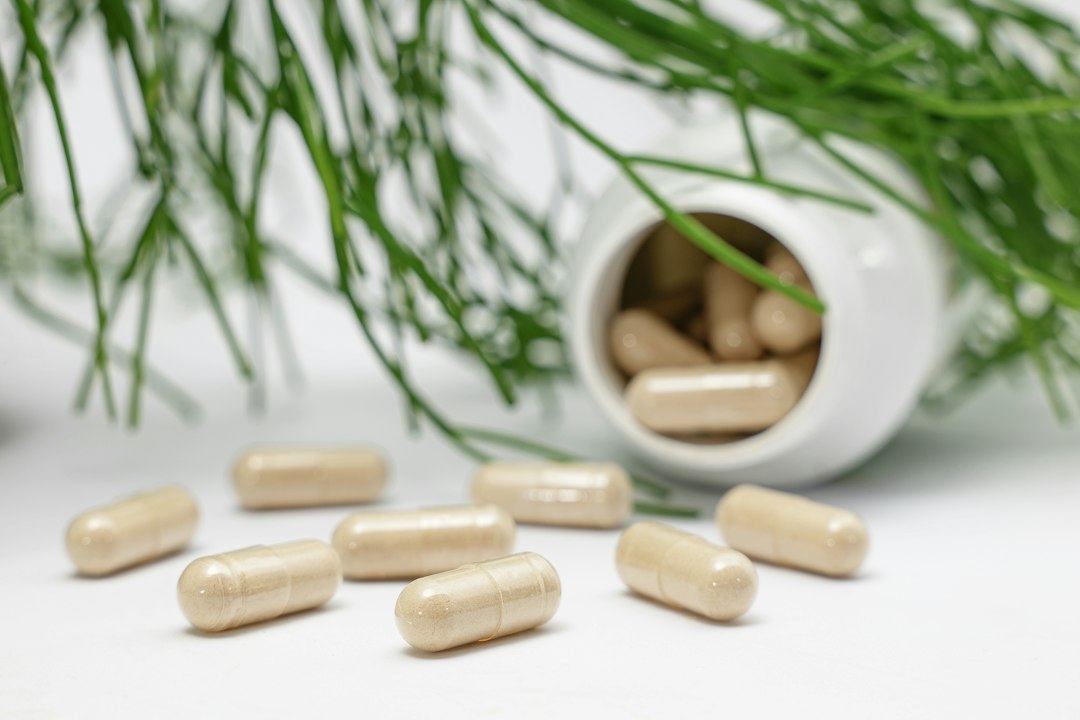
Photo: Supliful – Supplements On Demand / Unsplash. Illustrative image; no endorsement implied.
Health Content Works | Evidence reviewed September 2026
Author and human reviewer: David L. Carpenter, BSN, RN — licensed Registered Nurse; 10 years of nursing practice and 24 years of healthcare experience. Read our editorial and AI-use standards.
Searches for “natural Ozempic,” “natural GLP-1,” and “GLP-1 supplements” have become common as people look for less expensive or nonprescription ways to lose weight. The problem is that the marketing language often gets far ahead of the evidence.
No dietary supplement has been shown to reproduce the magnitude, consistency, or clinical-outcomes evidence of prescription semaglutide or tirzepatide. Some supplements and foods may modestly affect appetite, glucose, bowel function, or body weight, but that is not the same as being a natural version of a GLP-1 medication.
What does “natural GLP-1 alternative” even mean?
The phrase is mostly a marketing term, not a medical category. Your body naturally produces GLP-1 after eating, and food composition can influence gut hormones and satiety. That does not mean a food or supplement functions like a prescription GLP-1 receptor agonist.
Semaglutide is engineered to activate the GLP-1 receptor for a prolonged period. Tirzepatide activates both GLP-1 and GIP receptors. Their effects are produced by pharmacologic exposure at doses tested in large clinical trials. A supplement that slightly changes post-meal GLP-1 levels is not automatically equivalent in mechanism or effect.
Berberine: probably the most overhyped comparison
Berberine is often promoted online as “nature’s Ozempic.” That comparison is not supported by clinical evidence.
A 2026 systematic review and meta-analysis of 23 randomized trials found that berberine was associated with an average reduction in body weight of about 0.88 kg, BMI by about 0.48 kg/m², and waist circumference by about 1.32 cm compared with control groups. The authors also noted important limitations in trial quality and reporting.
Those findings suggest that berberine may have modest metabolic effects in some settings. They do not show anything remotely comparable to the double-digit percentage weight loss seen in modern obesity-medication trials.
Berberine can also interact with medications and may not be appropriate during pregnancy or in people with certain medical conditions. “Natural” should never be interpreted as “interaction-free” or “risk-free.”
Psyllium fiber: useful, but not a GLP-1 drug
Psyllium is a soluble, gel-forming fiber with evidence for improving bowel regularity and some metabolic measures. It can increase fullness in some people and can be useful for constipation.
The weight-loss evidence is inconsistent. A 2023 review of six selected trials reported approximately 2.1 kg greater weight loss with psyllium, while an earlier meta-analysis of 22 randomized trials found no significant effect on body weight. A 2025 meta-analysis also did not support a reliable weight-reduction effect and actually reported a pooled increase in body weight, illustrating how sensitive conclusions can be to study selection and methods.
The most defensible conclusion is that psyllium can be a useful source of fiber and may help some people with satiety or constipation. It should not be sold as a substitute for semaglutide or tirzepatide.
Cinnamon: small average effects, not medication-like weight loss
Meta-analyses of randomized trials have reported small reductions in body weight and BMI with cinnamon supplementation. For example, an umbrella meta-analysis published in 2022 estimated an average weight reduction of roughly two-thirds of a kilogram.
That can be scientifically interesting without being clinically equivalent to modern obesity pharmacotherapy. Cinnamon is a food and supplement ingredient, not a GLP-1 receptor agonist, and evidence does not support calling it a natural replacement for Wegovy or Zepbound.
Probiotics: strain-specific and uncertain
Probiotics are another category sometimes marketed for weight loss. Reviews suggest that certain strains or combinations may have small effects on body weight or body composition, but results vary substantially across products, strains, doses, populations, and study methods.
This matters because “probiotic” is not one treatment. A positive trial of one strain cannot be generalized to every probiotic capsule on a store shelf.
What about foods that increase GLP-1 naturally?
Protein, certain fibers, and mixed meals can stimulate normal gut-hormone responses, including GLP-1. This is part of normal human physiology and one reason diet composition can influence fullness.
But there is a critical distinction between supporting normal satiety signaling and producing pharmacologic receptor activation. Eating protein, legumes, oats, vegetables, or fermented foods may support a nutritious eating pattern. It does not create an oral equivalent of semaglutide.
Can high-protein or high-fiber eating still help with weight management?
Yes. A higher-protein eating pattern can increase fullness in some people and can help preserve muscle mass during weight loss. Fiber-rich foods can support bowel function, diet quality, and satiety, although weight-loss effects vary by fiber type and overall diet.
These strategies are valuable because they support health and can complement obesity treatment. They should be framed as nutrition strategies—not as disguised pharmaceutical substitutes.
For practical meal-planning guidance, see High-Protein, High-Fiber Meal Planning for GLP-1 Users.
Why supplement claims deserve extra skepticism
In the United States, dietary supplements are regulated differently from prescription drugs. The FDA does not approve dietary supplements for safety and effectiveness before they are marketed in the way it approves medications.
The FDA also maintains ongoing warnings about weight-loss products contaminated with undeclared drug ingredients. Some products advertised as “all natural” have contained hidden pharmaceuticals or other substances that can cause serious harm.
A product being sold online, carrying a supplement label, or having thousands of positive reviews does not prove that it is effective, uncontaminated, or appropriate for a particular person.
Red flags for “natural GLP-1” products
- Claims that a supplement works “just like Ozempic” or “activates GLP-1 the same way” without human comparative trials.
- Before-and-after photos presented as proof of efficacy.
- Large weight-loss promises over a few weeks.
- Proprietary blends that do not clearly disclose ingredient amounts.
- Claims that “natural” means there are no side effects or medication interactions.
- Testimonials used in place of randomized controlled evidence.
- Products sold as a way to replace a prescribed medication without involving the prescriber.
What actually has the strongest evidence?
For clinically significant obesity, the strongest evidence for substantial weight reduction comes from comprehensive obesity treatment that may include nutrition therapy, physical activity, behavioral treatment, FDA-approved medications, and—in appropriate patients—metabolic or bariatric surgery.
Supplements may have a role in correcting nutrient deficiencies or addressing specific symptoms when there is evidence and a clear reason to use them. That is very different from treating supplements as primary obesity medications.
A realistic evidence hierarchy
- Strongest evidence for large weight loss: FDA-approved obesity medications and metabolic/bariatric surgery in appropriately selected patients.
- Strong evidence for health support: sustainable dietary patterns, resistance and aerobic activity, sleep, and behavioral treatment.
- Potentially useful adjuncts: selected fibers, protein supplementation when needed, or other targeted nutrition support.
- Weak or inconsistent evidence: many over-the-counter weight-loss supplements marketed as metabolic boosters, fat burners, or “natural GLP-1s.”
Bottom line
There is currently no evidence-based “natural Ozempic” or natural substitute for tirzepatide or semaglutide. Some supplements such as berberine, psyllium, cinnamon, or selected probiotics may have modest or inconsistent effects on weight-related outcomes, but the magnitude and certainty of those effects are far smaller than the evidence supporting prescription obesity medications.
The most useful way to think about food and supplements is as support for nutrition, symptoms, and overall health—not as a pharmacologic imitation of GLP-1 therapy.
About the author
David L. Carpenter, BSN, RN is a licensed Registered Nurse with 10 years of nursing practice and 24 years of healthcare experience. He is the founder and editor of Health Content Works, with a focus on evidence-based education about obesity, GLP-1 medications, nutrition, exercise, metabolic health, and practical healthy living.
David also brings lived experience with obesity, weight loss, and GLP-1 treatment. His personal experience helps shape the practical questions explored by Health Content Works, while medical conclusions are grounded in research, clinical guidance, and authoritative sources.
References
1. Vahed IE, et al. The effect of berberine on obesity indices: a systematic review and meta-analysis. Int J Obes (Lond). 2026;50(1):53-73. PMID: 41310257. DOI: 10.1038/s41366-025-01943-x.
2. Gibb RD, et al. Psyllium is a natural nonfermented gel-forming fiber that is effective for weight loss: a comprehensive review and meta-analysis. J Am Assoc Nurse Pract. 2023;35(8):468-476. PMID: 37163454.
3. Mofrad DM, et al. The effects of psyllium supplementation on body weight, BMI and waist circumference in adults: a systematic review and dose-response meta-analysis of randomized controlled trials. Crit Rev Food Sci Nutr. 2020;60(5):859-872. PMID: 30880409.
4. Paknahad Z, et al. The effect of psyllium consumption on anthropometric indices: a systematic review and dose-response meta-analysis of randomized controlled trials. 2025. PMID: 41126340.
5. Keramati M, et al. Cinnamon, an effective anti-obesity agent: evidence from an umbrella meta-analysis. J Food Biochem. 2022;46(8):e14166. PMID: 35365881.
6. Sadeghi A, et al. Efficacy of Probiotics in Overweight and Obesity Control: An Umbrella Review and Subgroup Meta-Analysis. 2024. PMID: 39320636.
7. U.S. Food and Drug Administration. Information for Consumers on Using Dietary Supplements; Weight Loss Product Notifications. Accessed September 2026.
This article is for general education and is not individualized medical advice. Dietary supplements can interact with medications and medical conditions. Discuss supplement use with a qualified healthcare professional.