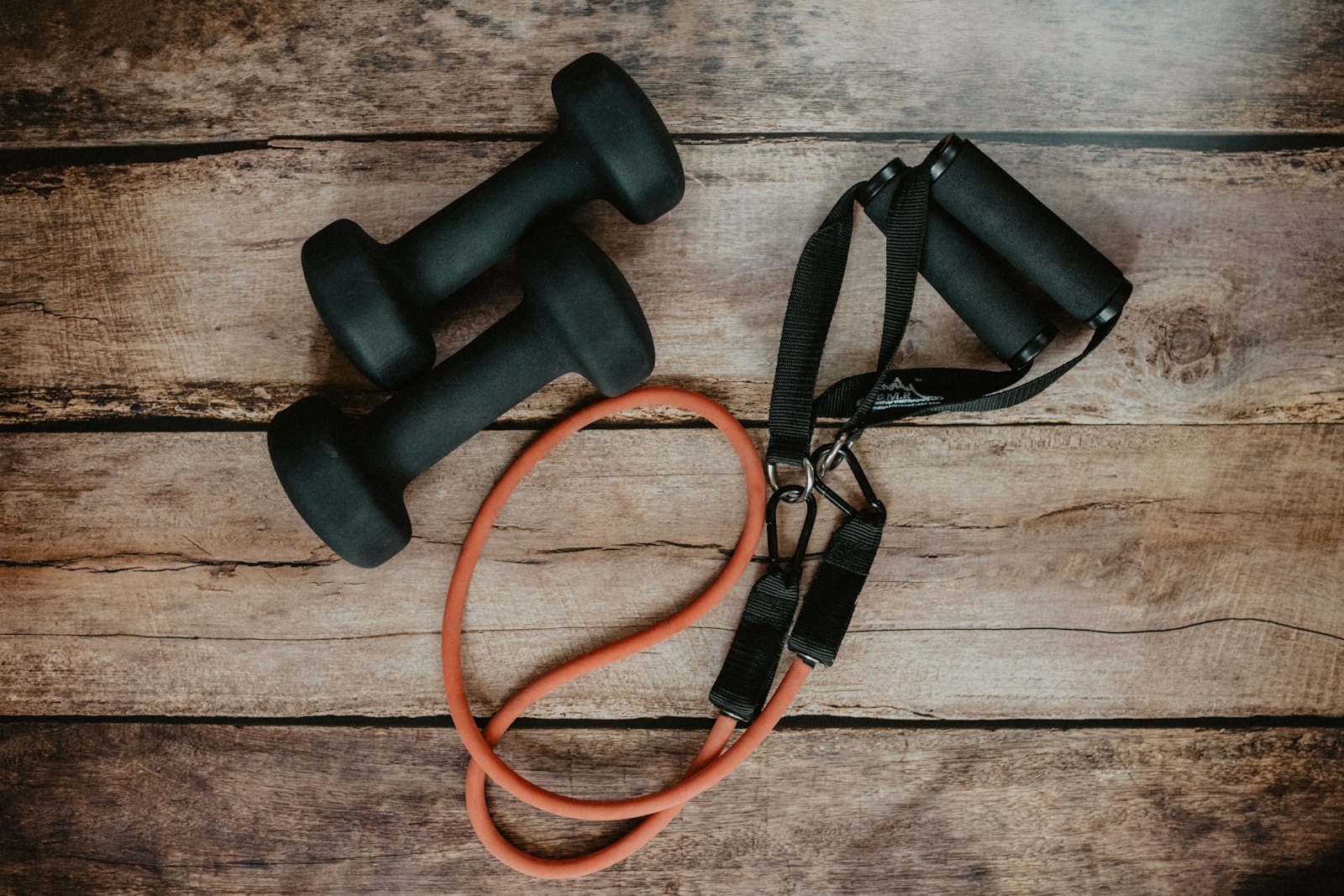
Featured photo: Kelly Sikkema / Unsplash. Illustrative equipment photo; no endorsement implied.
Evidence checked: September 25, 2026. Educational information, not individualized medical advice or instructions to change a medication dose.
If you are taking Wegovy (semaglutide) or Zepbound (tirzepatide), a lower number on the scale may be only part of what you want. Getting out of a chair more easily, carrying groceries, and feeling capable in daily life matter too.
Strength training can help you work toward those everyday goals. You do not need to begin with heavy weights or a complicated gym routine. The useful starting point is movement you can control, equipment that feels stable, and a level of effort you can repeat.
Walking, resistance exercise, adequate food and fluids, and recovery each have a role. The research reviewed here supports including strength work during weight loss, but it does not establish a guaranteed muscle-preservation program for every person taking Wegovy or Zepbound.
Walking versus resistance training
Walking is aerobic activity. It can improve fitness, support mobility, provide a manageable starting point, and help with mood and daily energy. It also counts when broken into short, comfortable bouts. Walking alone, however, does not provide the same progressive loading stimulus as resistance exercise for the muscles used in pushing, pulling, lifting, and rising.
Resistance training asks muscles to work against an external or body-weight load. It may help improve strength and function even when body weight changes little. They provide different benefits and can fit into the same week. U.S. Physical Activity Guidelines recommend adults work toward at least 150 minutes of moderate aerobic activity weekly and muscle-strengthening activity on at least two days weekly, involving all major muscle groups. Those are population-level goals—not a pass/fail test and not a day-one prescription. CDC adult activity guidance
If walking is currently difficult, begin with what is tolerable: a few minutes, seated or water-based movement, or repeated trips around the home may be more realistic than a long walk. If joint pain, breathlessness, balance problems, or fatigue limits activity, individualized guidance can help identify safer options.

Beginner-friendly ways to start resistance training
Choose equipment that feels stable and accessible:
- A sturdy chair: Sit-to-stand practice and supported heel raises can train useful movement patterns. Use a stable support for balance. The chair should not slide or roll.
- Resistance bands: Bands are inexpensive and available in different tensions. Anchor them only to secure points and avoid snapping them toward the face.
- Light dumbbells or household objects: Small weights, water bottles, or canned goods can be used for controlled rows, presses, or curls if the grip is safe.
- Machines: A supervised gym or community center may offer back support and adjustable loads, which can be helpful for beginners or people with balance limitations.
- Body weight: A wall push-up, supported squat to a chair, or step-up can be modified by changing the range of motion and support.
Start with a small number of movements that cover the legs, hips, chest, back, shoulders, and trunk. Use slow, controlled repetitions and stop if form breaks down. A beginner does not need to train to exhaustion. The goal is repeatable practice. If a movement feels unstable or unfamiliar, a physical therapist or qualified exercise professional can help adapt it.
This section contains an affiliate link. As an Amazon Associate I earn from qualifying purchases. Read our affiliate disclosure.
If you want bands for home practice, a color-coded beginner kit such as the THERABAND beginner resistance band set (yellow, red, and green) lets you start with the lightest band and move up one level at a time. If you are sensitive to latex, choose the non-latex version on the same product page, and check bands for nicks or tears before each use.
Progress gradually
Progress can mean adding a repetition, using a slightly stronger band, increasing the range of motion, adding a small amount of load, or making the same exercise feel easier with better control. Change one variable at a time and allow recovery. A short record of the exercise, resistance used, and how it felt can help you notice progress without chasing a number on the scale. Soreness is not the goal, and pain—especially sharp, worsening, or joint pain—is a reason to stop and reassess.
Medication-related nausea, early fullness, vomiting, diarrhea, or reduced appetite can make hydration and food intake harder. On a day when you feel unwell, a shorter, easier session—or rest—may be more appropriate. Do not change or skip medication because of an exercise plan without discussing it with the prescribing clinician.
The 2025 joint nutrition advisory emphasizes adequate nutrition, including protein-rich foods, but it does not establish one perfect amount for every person. Kidney disease, liver disease, age, body size, frailty, pregnancy, eating-disorder history, and other medical factors can change what is appropriate. Protein supplements are not mandatory, and they cannot replace a varied diet, fluids, or training.
When to ask for individualized guidance
Speak with your clinician before major exercise or nutrition changes if you have significant heart or lung disease, uncontrolled blood pressure, diabetes-related complications, kidney disease, severe mobility problems, frailty, or substantial unintended weight loss. A physical therapist can help adapt movement; a registered dietitian can help when intake is inadequate or an eating-disorder history makes weight-loss advice more complicated. Pregnancy or breastfeeding warrants a separate medication discussion with your prescriber.
Stop exercising and call 911 for possible heart-attack symptoms, such as new chest pressure or discomfort, especially with shortness of breath, sweating, nausea, or lightheadedness. Do not wait for a routine appointment. American Heart Association warning signs
Persistent vomiting or diarrhea, difficulty keeping fluids down, ongoing dizziness, or marked weakness needs prompt clinical advice. These symptoms should not be treated as a normal workout challenge. If symptoms are severe or you think it is an emergency, seek emergency help.
Lean mass, skeletal muscle, and strength are not the same
These terms are often used as if they were interchangeable, but they measure different things:
- Lean mass is a broad body-composition category. DXA separates fat, lean soft tissue, and bone mineral. Lean soft tissue includes skeletal muscle, water, organs, and other non-fat soft tissues. It is not a direct measurement of contractile muscle. “Fat-free mass,” another common term, also includes bone mineral.
- Skeletal muscle is the muscle tissue attached to bones that helps you move. It is only one component of lean mass.
- Strength is what you can produce in a task—such as standing from a chair, carrying groceries, or lifting a weight. Strength also depends on the nervous system, technique, pain, balance, joint function, and practice.
Therefore, a change in DXA lean mass does not automatically prove that someone lost the same amount of skeletal muscle, and a body-composition result does not tell the whole story about strength or daily function.
What do we know about Wegovy and Zepbound?
Direct evidence in semaglutide users
A 2024 real-world observational study followed adults with type 2 diabetes treated with subcutaneous semaglutide and reported decreases in lean mass over follow-up. It was not a randomized exercise trial: there was no resistance-training intervention, no untreated comparison that can establish causation, and the researchers used bioelectrical impedance analysis (BIA), which estimates body composition and can be affected by hydration. Its population was people with type 2 diabetes, so it is not a direct test of an exercise plan for all Wegovy users. It tells us that estimated lean-mass change can occur during treatment; it does not tell us that semaglutide causes a fixed amount of muscle loss or that exercise prevents it. Pantanetti et al., 2024, PubMed
Other semaglutide analyses have used DXA or other body-composition measures, but they do not consistently measure skeletal-muscle tissue and strength together. The practical gap is important: we need more trials that test resistance training while measuring body composition, physical performance, and patient-relevant function.
Direct evidence in tirzepatide users
A 2025 DXA substudy from SURMOUNT-1 analyzed 160 adults with obesity or overweight without diabetes: 124 receiving tirzepatide and 36 receiving placebo. At 72 weeks, tirzepatide was associated with substantial reductions in body weight and fat mass; absolute lean mass also decreased, and roughly one-quarter of weight lost was lean mass. The placebo group had a similar fat-to-lean split, although it lost much less weight overall. These are group averages, not a forecast of any individual’s muscle loss. This was a medication-trial substudy, not a resistance-training trial. Look et al., 2025, PubMed · DOI
The study does not establish that the lean tissue measured was all skeletal muscle, nor whether participants became weaker. It also does not prove that resistance training would have changed the result. Those are reasons to avoid headlines promising that lifting weights “stops” muscle loss.
Why resistance training is still worth considering
Evidence from adults with overweight or obesity—not specifically Wegovy or Zepbound users—provides a useful but indirect rationale. A 2025 systematic review and meta-analysis of 25 randomized trials found that adding resistance exercise during dietary weight loss did not necessarily produce more total weight loss, but it was associated with better preservation of fat-free mass, greater fat loss, and improved strength. The authors rated certainty as moderate for fat-free-mass preservation, high for fat loss, and low for strength. Binmahfoz et al., 2025, PubMed
That is different from direct proof in GLP-1 medication users. The studies varied in diet, training design, duration, supervision, age, health status, and how lean mass was measured. Results from people using other weight-loss medicines or no medication cannot be automatically transferred to semaglutide or tirzepatide.
The 2025 multisociety advisory on nutritional priorities during GLP-1 therapy makes a similar practical point: nutrition should support muscle, bone, and function, and resistance training should be part of a broader care plan. The advisory discusses protein and exercise priorities, but its proposed protein ranges are based on indirect evidence and clinical judgment—not a dedicated GLP-1 protein-dose trial. It is not a reason to pursue an extreme diet or a universal protein target. 2025 joint advisory—PubMed · full text
A workable starting point
For someone taking Wegovy or Zepbound, walking and resistance training are complementary. The medication studies discussed here show that lean mass can decline during weight loss, but they do not prove a specific amount of skeletal-muscle loss, a loss of strength, or a guaranteed benefit from any one exercise plan. General obesity and exercise evidence supports resistance training as a sensible way to work on strength and function while losing weight. Start where you are, progress gradually, fuel adequately, and ask for individualized help when health conditions or symptoms make the plan less straightforward.
Evidence table
| Evidence source | What it studied | What it can support | Key limitation |
|---|---|---|---|
| SURMOUNT-1 DXA substudy, 2025 | Tirzepatide users; DXA body composition at 72 weeks | Lean mass can decrease during tirzepatide-associated weight loss | No resistance-training intervention; lean mass is not identical to skeletal muscle or strength; Figure 4 units corrected from percent to kilograms |
| Semaglutide real-world study, 2024 | Adults with type 2 diabetes treated with semaglutide; body weight/composition and clinical measures | Lean-mass changes occur in real-world semaglutide treatment | Observational; no randomized exercise comparison; population differs from all Wegovy users |
| Resistance-exercise meta-analysis, 2025 | 25 randomized trials in adults with overweight/obesity during dietary weight loss | Resistance exercise may support fat-free mass and strength | Indirect to semaglutide/tirzepatide; heterogeneous programs and measurements |
| 2025 GLP-1 nutrition advisory | Multisociety clinical priorities for nutrition and activity during GLP-1 therapy | Supports attention to nutrition, function, and resistance training | Advisory, not a GLP-1 resistance-training trial; some recommendations rely on indirect evidence; 2026 correction clarifies a cited dietary-counseling study |
| CDC adult activity guidance | Population-level physical-activity guidance | Aerobic and muscle-strengthening activity are complementary | General guidance, not individualized medical care |
Related reading from Health Content Works
- How Much Protein Do You Need on Wegovy, Zepbound, or Other GLP-1 Medications?
- High-Protein, High-Fiber Meal Planning for GLP-1 Users
Source corrections reviewed
- Tirzepatide substudy: The August 2025 correction changes the units on the fat-mass and lean-mass graphs in Figure 4 from percentages to kilograms. The group-level fat/lean split discussed above is reported in the study abstract. Publisher correction
- 2025 nutrition advisory: The April 2026 correction clarifies that a cited trial compared calorie restriction with dietary counseling against liraglutide alone. It was not an observational comparison of GLP-1 treatment with versus without counseling. The authors state that the advisory’s conclusions are unchanged. Publisher correction
Leave a Reply